
What happens to the box, and what it costs to change it
Two toggles control which original packaging travels, and six paid options offer different kinds of protection. Their effect on the shipping charge depends on the final parcel and the selected line’s billing rules.
 Sneakers
 Outerwear
 Hoodies
 Eyewear
 Bags
The two toggles, and the six options under them
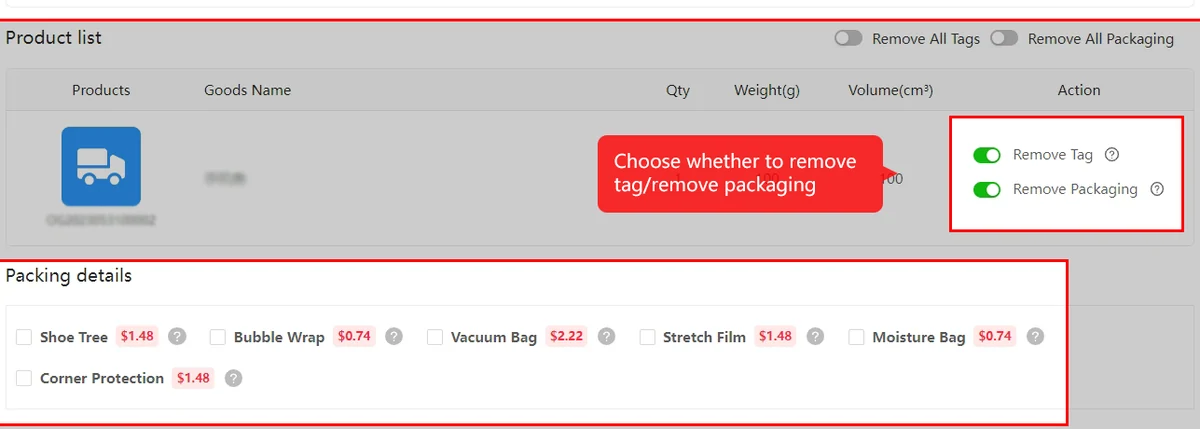
Removing packaging may change parcel dimensions and actual weight, but it can also reduce protection or affect return eligibility. Whether it changes the charge depends on the selected line’s rules. Removing tags or packaging does not guarantee easier customs clearance.
Packing services can add material, compress suitable goods or change how items fit together. Compare the measured packed parcel and quote; do not assume that every option increases or reduces the billed weight.
What each option is actually for
| Option | What it is for | What it does to the parcel |
|---|---|---|
| Shoe tree | Keeping a shoe in shape once its box is gone | Adds support and material; any space saving depends on the final packing arrangement. |
| Bubble wrap | Anything with a hard edge or a lens | Adds protective material; check its effect on the packed weight and dimensions. |
| Vacuum bag | Hoodies, coats, anything with loft | May reduce dimensions for suitable compressible goods. It does not change the line’s volumetric divisor. |
| Stretch film | Holding a group of soft items together | Adds wrapping material; the effect on weight and dimensions depends on how it is used. |
| Moisture bag | Items needing an additional moisture barrier | Adds a moisture barrier; confirm suitability and the effect on the packed parcel. |
| Corner protection | Boxed goods you are keeping boxed | Adds protection at the corners of a retained box; check the final dimensions and weight. |
The screenshot records the available options, not measured savings or guaranteed protection. Their effect depends on the items, packing requirements and selected shipping line.
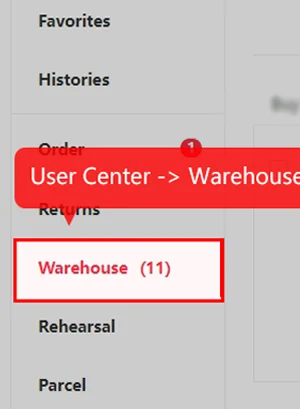
Rehearsal measures the requested packing
The captured help article 117 describes paid pre-packing to obtain parcel weight information before dispatch. Check the current service charge and whether a measurement would help with your packing or shipping decision.
Rehearsal can be useful when the estimate is near a line limit, when the packaging is uncertain or when the measured parcel could change your route choice.
The result measures the requested packing configuration. If the actual parcel’s packing requirements differ, article 117 says the parcel weight may not be updated from that result; check the final measurements and quote.
Added protective materials and removal of original packaging can change the weight and dimensions in either direction. Individual warehouse entries are not a substitute for the final packed parcel measurement.
Article 117 permits two routes: request rehearsal for an already-submitted parcel before freight payment, using its S parcel number, or request it for eligible warehouse items before submission, using their OG order numbers.
Decide the combination before requesting a rehearsal
Take a boxed pair of shoes and a soft jacket. If preserving the shoe box matters, record that first; if compression is acceptable for the jacket, confirm the relevant service and limits. The proposed parcel must reflect the packing you actually want before a rehearsal can answer your weight-and-volume question.
Compare the resulting measurements against the route’s current billing basis and restrictions. Extra protection may add weight or size while reducing exposure to damage. Removing a box can reduce volume but loses the original packaging. Neither choice guarantees a lower final charge or a successful customs outcome.
If you change the included items after an estimate or rehearsal, ask which parts of that result still apply and whether a new request is needed. Review return eligibility before removing tags or packaging. The packing decision should follow the QC decision, not substitute for it.
Use the planner as an early check, then decide whether rehearsal would resolve a measurement or packing uncertainty before paying for freight.
Quality check is also where the weight appears
Warehouse measurements help with planning, while QC addresses visible appearance. The captured inspection rules cover model, style and size, with opening limited to eligible garments, bags, suitcases and shoes; sealed packaging is not opened.
QC photos help you compare visible details with the ordered variant. They do not establish that every part of the description is correct. For electronics, the published inspection explicitly excludes authenticity, function and quality testing.
How to check the QC photos before you combine
Check it against the variant you chose
Compare the visible model, colour and size label with the selected variant. Ask for a clearer view or measurement if the available photos do not answer the question.
Check what it arrived in
The photographs show the packaging you are about to decide whether to remove. A shoe box visible here is volume you can still choose not to ship.
Check it before the clock gets interesting
Review the photos promptly and check the actual after-sales deadline. The captured return rules describe a usual 120-hour request window from the next hour after Stocked in, subject to eligibility and the actual order; waiting a full week may be too late.
Do not read them as an authenticity check
The operator rules that out in writing. Treating them as proof anyway is the usual route to shipping something you had already talked yourself out of.
QC and warehouse readings are useful checks, but neither establishes the final shipping charge. Use final packed measurements and the selected line’s rules for the shipping decision.
Consolidation itself is free
The captured help centre lists inspection and consolidation as free services. International freight, selected packing services, storage extensions and other applicable charges are separate. Compare the actual parcel quotes and each order’s deadline.
Help article 75 describes one domestic delivery charge when items from the same seller are submitted and paid together in one purchase order. An overweight shipment can still require a delivery-fee top-up; the number of sellers alone does not establish the final amount.