
Weight floors, ceilings and the divisor that overrules both
Four destinations, read off the operator's own estimator on one day. The numbers here decide what you may use, never what it costs.
 Outerwear
 Denim
 Football shirts
 Jewellery
 Watches
A floor is a weight below which a route refuses the parcel. A ceiling is a weight above which it refuses the parcel. Both are published, both are easy to miss, and between them sits a divisor that can make a light parcel heavy on paper.
United States
Thirteen lines were returned for a 1 kg parcel. Two of them cannot be picked at that weight, and the page tells you so in yellow rather than by hiding them.
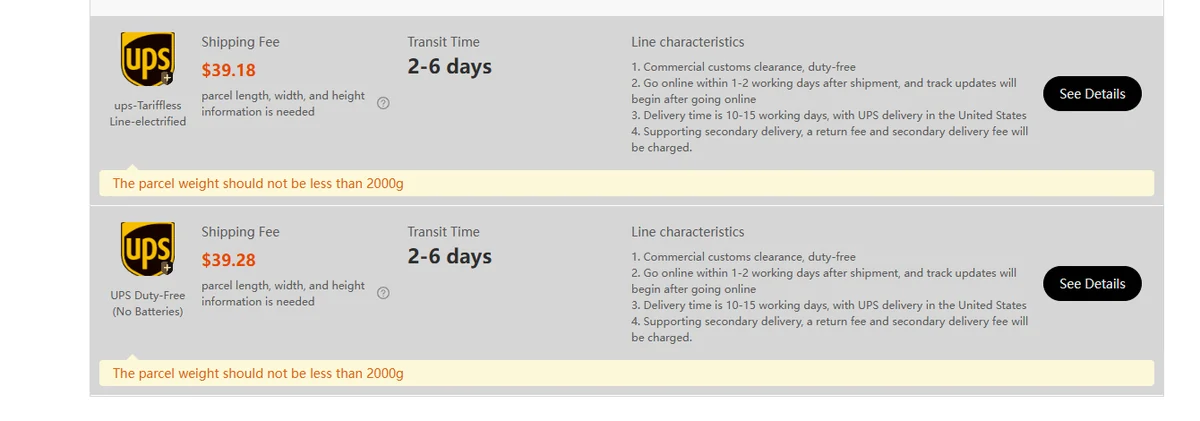
Read as a table rather than a screenshot, the three rules on that page look like this.
Price and transit time still shown. The yellow note underneath is the only thing saying why you cannot pick it.
The same floor on a second UPS route, so clearing 2000 g opens two rows at once rather than one.
Written into the route description rather than a grey-out: the actual weight limit is 2 kg, an estimated weight within 2150 g can be attempted, and above 2 kg you need a different route.
The arithmetic is tighter than it looks. Both UPS floors and the EUB ceiling sit on the same number, and the floors read not less than 2000 g while the ceiling reads a limit of 2 kg. A parcel weighing exactly 2000 g therefore satisfies all three at once, and it is the only weight that does.
A kilogram under that, the two UPS lines are closed and EUB is open. A kilogram over, the reverse. Which is worth knowing before you add one more t-shirt to a parcel that was already sitting on the line.
United Kingdom, Poland and Germany
The same line appears on both destinations with the same floor, which is a useful sign that these numbers belong to the route and not to the country.
The heavy variant of a route whose ordinary version you can use far lighter. The bracket in its own name is the clue.
No weight minimum appeared on any German line on the day we read it. Absence of a note is not a promise: read the line before you pay.
Two things are worth taking from this. The HKUPS floor is the same number in two countries, so it belongs to the route. And Germany showed no minimum at all on the day we looked, which is information about that day, not a rule.
The divisor, and why a light parcel can be charged heavy
| What is measured | How | What it means for a haul |
|---|---|---|
| Actual weight | The parcel on the scale after packing | This is the number the floors and ceilings are checked against. |
| Volumetric weight | Length x width x height, divided by a number between 5000 and 8000 | A box of coats can score higher here than on the scale. |
| Chargeable weight | The larger of the two | Which is why compressing bulky items is worth more than removing light ones. |
Divisors are per route, not per country, and they are written in the route description rather than anywhere prominent. If a parcel is bulky, the divisor is the first thing to read and the price is the second.
Above ten kilograms it stops being a weight question
Help article 21 says a parcel over 10 kg is more likely to be treated as commercial, and names a second trigger alongside it: too many identical items in one box. Neither is a route rule. Both are customs questions, and they are covered on the customs page.
For planning purposes it works as a soft ceiling above every route-level one. A haul that crosses it has stopped being a packing decision.
Questions this page gets
Why does a route I cannot use still show a price
Because the estimator quotes first and filters second. The line renders with its fee and transit time, then greys out, and the reason appears as one line of yellow text below it. If you are scanning prices rather than reading lines, you will plan around a route that was never available.
Is the weight it checks my items or my parcel
The packed parcel. Added packing materials and removal of original packaging can change weight and dimensions in either direction. Use the final measurements and the selected line’s rules; the sum of warehouse entries is only an estimate. Rehearsal can help measure the requested packing configuration.
What is the divisor and when does it bite
Volumetric weight is length times width times height divided by a number, and the larger of actual and volumetric is charged. The divisors we read ranged from 5000 to 8000, with 8000 on UK routes. A bigger divisor is friendlier to bulky parcels.
Does clearing a floor make a route a good idea
No. It makes it selectable. Price, transit time and whether the route carries what is in your box are three separate questions, and the last one is on the what-ships page.
Next
- Put a weight against these rulesPick a destination and read the verdict
- Change the weight on purposeTags, packaging, compression and the rehearsal pack
- Before the weight: what the route carriesBatteries, liquids and restriction flags
- The other constraintCheck the earliest applicable deadline for the selected orders