
Sixteen shelves of the Kakobuy Spreadsheet
The catalogue groups listings by what the thing is. This page re-reads the same sixteen groups by what they do to a box.
Scrolling a shelf wins over typing a query whenever the word has not occurred to you yet. On a haul it wins for a second reason: the live question is no longer what to buy but what to put in next, and that is answered by shape rather than by name.
 Category
Sneakers
Boxes, not shoes
Ask for the box to come out and a pair stops being the thing that decides your volume.
 Category
Outerwear
Loft, not weight
Down is the textbook volumetric case: light in the hand, expensive by the divisor.
 Category
Hoodies
Compresses hard
A vacuum bag earns its place here faster than anywhere else on this wall.
 Category
Tees
Flat, light, cheap to add
The easiest thing to add when a parcel sits just under a route's floor.
 Category
Denim
Dense
Denim adds weight without adding much volume, which is the direction you want.
 Category
Joggers
Compresses well
Same family as hoodies: soft, bulky until compressed, then unremarkable.
 Search
Womenswear
Light, varied
Light pieces are what quietly keep a haul under a floor it needed to clear.
 Category
Football shirts
Flat, very light
Shirts are the lightest way to fill a box, which is also how a box ends up too light to ship.
 Category
Bags
Shape you cannot squash
A structured bag sets the volume on its own, and the dust bag adds to it.
 Category
Caps
Awkward to pack
Caps keep their shape unless you decide otherwise; the warehouse will not decide for you.
 Category
Belts
Dense, fits gaps
Coiled, heavy for their size, and they fill the gaps other items leave.
 Category
Eyewear
Small, fragile
Hard cases are a reinforcement question before they are a weight question.
 Category
Fragrance
Restricted
Liquid. Several routes exclude it outright, so read the line before you add one to a parcel.
 Category
Jewellery
Negligible weight
Adds nothing to the scale, so it cannot lift a parcel over a floor.
 Category
Watches
Dense, boxed
Boxed, dense, and the box is usually the bigger half of the volume.
 Category
Electronics
Battery rules apply
A battery changes which routes you can see at all, not just what they cost.
From a card to a line in your warehouse
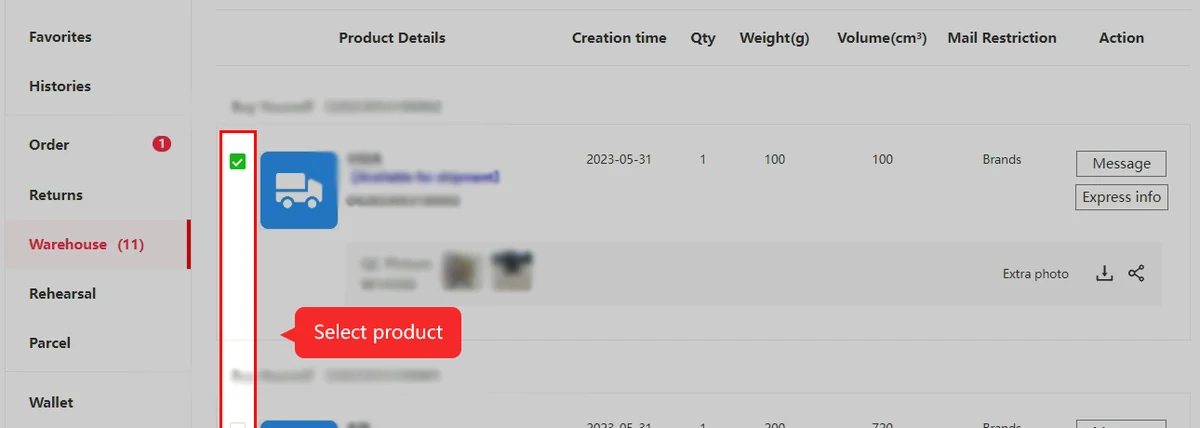
A card has a photograph and a title. A warehouse entry has a weight in grams, a volume in cubic centimetres and a mail restriction flag. Those three decide everything this site is about, and none of them exist until the item has arrived.
Which is the awkward shape of the whole exercise: you choose what to buy with no weight information, and you choose a route with no way to go back and change what you bought.
What to add, and what to stop adding
| If your parcel is | Add from | Avoid adding |
|---|---|---|
| Just under a route's floor | Denim, belts, boxed watches | Jewellery and eyewear: they weigh almost nothing. |
| Near a route's ceiling | Nothing. Start a second parcel. | Outerwear above all, because loft costs volume not grams. |
| Bulky but light | Dense small items that fill the gaps | More of the same. Two coats is the same problem twice. |
| Approaching 10 kg | Nothing | Multiples of one item, which the help centre names separately as a commercial-parcel trigger. |
The thresholds behind this table are listed with their sources on the weight bands page.
How to choose a seller when you are building a haul
For a single order the seller question is about the item. For a haul it is also arithmetic: domestic shipping to the warehouse is charged once per seller order, and every extra seller is another dispatch that can run late.
So two of the usual signals matter more here than they otherwise would. A shop holding several of the things you want beats a marginally better price across two shops. And a shop whose listings show recent activity beats one whose stock may not move for a fortnight, because the storage clock is already running on your earliest arrival.
Nothing here judges a shop for you, and neither does the service: its inspection covers appearance, model and style, and its own text says authenticity is not something it can identify.
How to judge a listing before you add it to a parcel
Judging a listing before you commit is mostly about shape, not price. Three questions do the work.
| Question | Why it matters to a haul | Where to look |
|---|---|---|
| Does it ship in a box you do not want | A box is volume, and volume is charged by divisor. | The listing photographs, then the packing toggles later. |
| Is it one item or a set | Several identical items in one parcel is a named commercial-parcel trigger. | The listing title and the variant choices. |
| Is it liquid, battery-powered or fragile | Each of the three changes which lines you may use at all. | The listing, then the mail restriction flag on arrival. |
Why this spreadsheet, and how it is kept
Every outbound address here was requested and answered before publication, and the dated figures are listed with their sources on the checked-on page. Dead links and stale numbers are the two ways a guide like this rots, and both are checkable from outside.
What it adds over reading the operator's pages directly is ordering. The weight rules, the clock and the packing levers live in four separate help articles and an estimator, and the connection between them is not stated anywhere.
Where the goods come from
Shops elsewhere own these listings. Four marketplaces are parsed automatically according to the help centre: Taobao, Tmall, 1688 and JD.COM. A link from anywhere else has to be typed into a manual form, which the what-ships page goes through.
No item here is the forwarding company's stock, and none of it is ours either. This is a guide paid for by referrals, which the about page sets out properly.